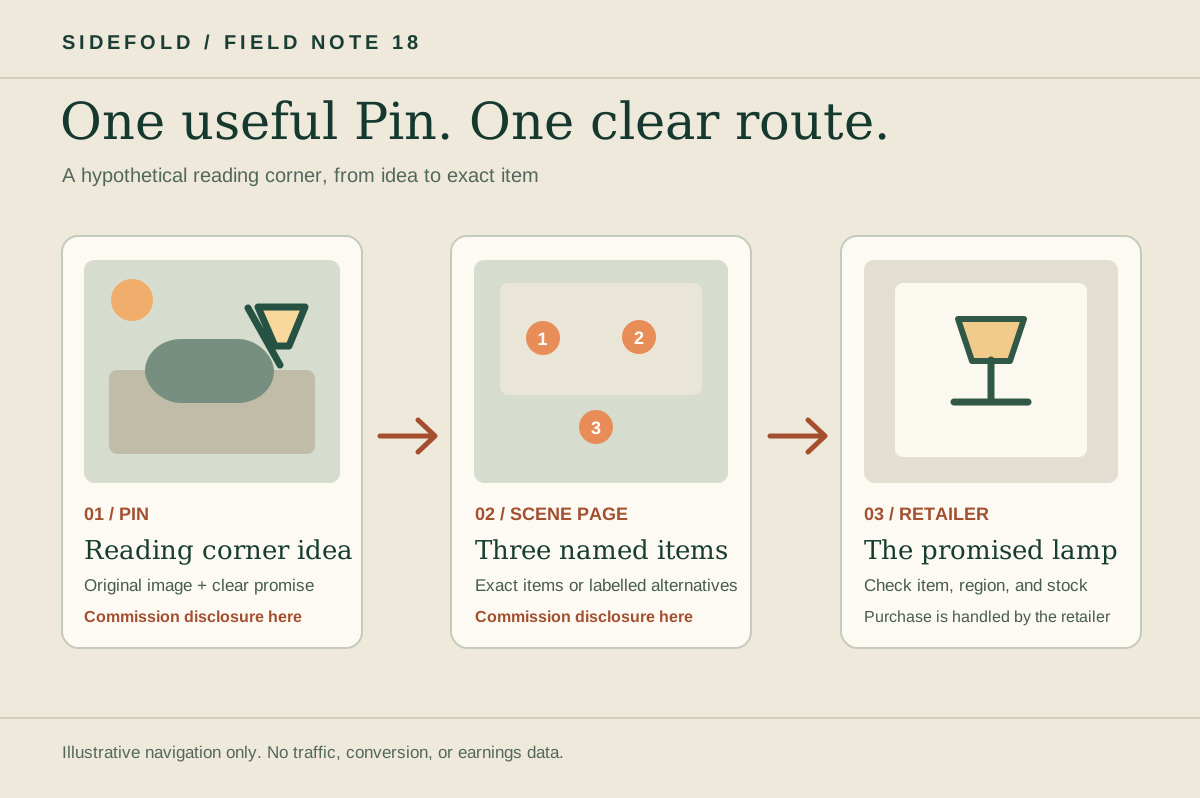
Someone saves a Pin about a reading corner, then opens it weeks later to find the lamp. If the link leads to a generic storefront, the useful idea disappears. Give the Pin a destination that answers the question it created.
This example is hypothetical: a creator photographs a small reading corner with a lamp, chair, and throw. The steps work for any recommendation you have actually used or researched. They do not predict clicks or income.
01
Choose the route before making the Pin
For one exact item, a direct link to the retailer may be the shortest path. For a scene with several products, a contextual page can explain which item is which, why each belongs in the scene, and which ones are alternatives. The Pin should lead to the page that best matches its promise.
Check your affiliate agreement first: are Pinterest Pins and the destination domain permitted placements? Must the site or social account be registered? Are link shorteners, product images, or price statements restricted? Pinterest’s Commercial and Branded Content Guidelines allow affiliate content subject to originality, transparency, and anti-spam rules. That permission does not override a retailer program’s terms.
Pin promises: “Three details in a compact reading corner.”
Destination: the same photo with a lamp, chair, and throw identified.
Retailer links: one exact item per label, or an honestly named alternative.
02
Make the Pin useful before the click
Use an original photograph or material you have permission to publish. Give the Pin a descriptive title, such as “Small reading corner with a warm task lamp,” and a description that explains the idea, not a string of product keywords. A useful caption might mention why the lamp sits beside the chair and what kind of light it gives. Do not describe a product as tested if you have not tested it.
Pinterest’s Pin creation guide says you can add a link while entering the Pin details. Add the URL of the specific page you chose, then save the Pin to a relevant board. Pinterest’s distribution guidance recommends linking to a page clearly related to the Pin. A Pin about one reading corner should not send visitors to an unrelated homepage or a different look.
The route diagram above shows the Pin, the scene page, and the product destination. It is a navigation example, not a conversion funnel or traffic chart.
03
Give every product its context on the destination page
On a page for the reading corner, keep the same image visible. Label the exact lamp model if you know it. If the original is unavailable, say “similar lamp” and state the meaningful difference, such as size or finish. Remove a link when the retailer page no longer matches the recommendation.
Sidefold shoppable posts let a creator place product markers on their own photo and attach product URLs and notes. The published page sends a visitor to the creator-supplied retailer destination; it does not sell that retailer item through a Sidefold checkout. Mark a link as affiliate when appropriate so the Sidefold page displays its commission disclosure. Confirm your affiliate program allows the Sidefold page as a link placement.
Keep the visible page helpful even for someone who buys nothing. Explain the arrangement, note any tradeoffs, and avoid unsupported claims about the item or your results. Our shop-the-look guide goes deeper on product labels and sold-out items.
04
Put the disclosure where the recommendation appears
If you may earn a commission, say so plainly on the Pin near the recommendation. A line such as “I may earn a commission if you buy through my links” tells a reader more than “affiliate link” alone. Pinterest requires commercial content to be clearly disclosed, and the FTC’s affiliate guidance says disclosures should be clear, conspicuous, and close to the endorsement. Requirements outside the United States may differ.
Disclose on the destination page too. A visitor may arrive there from a search result or another share without seeing the Pin. Sidefold displays a commission disclosure on a published shoppable post when the creator marks their own affiliate links, but you must still review the visible page and meet any wording required by your program. Pinterest’s paid partnership tool serves brand partnerships and has its own availability and approval flow; do not assume that it replaces a clear affiliate disclosure.
05
Test the public route, then maintain it
Open the live Pin on a phone, tap its link, find the promised product, and follow the product URL to the retailer. Check that the correct model, variant, country, and disclosure appear at each step. Then repeat from a private browser window so you see what a new visitor sees. If your program uses tracked links, use its permitted testing method instead of making a purchase to test attribution.
- Pin: Is the photo yours to use, and does the description match the destination?
- Page: Can someone identify each exact item or labelled alternative without guessing?
- Disclosure: Is the commercial relationship clear on the Pin and the page?
- Retailer: Does each URL still open the intended item in the reader’s market?
Recheck the route when an item sells out, a retailer changes a listing, or an affiliate agreement changes. Pinterest saves can bring someone back long after publication. A click recorded on your page is only a click; the affiliate provider’s validated purchase and payout records are separate.
06
Common questions
Can a Pin link straight to an affiliate product?
Pinterest permits affiliate content that follows its current Commercial and Branded Content Guidelines, but your affiliate program may set separate placement rules. A direct product link can suit one exact item; check both sets of terms and disclose the relationship on the Pin.
Do I need a Pinterest business account?
You can create a Pin with a link using Pinterest's Pin creation flow. A business account offers additional tools, but it does not replace the affiliate program's approval or disclosure requirements. Check the account and feature requirements for the tools you intend to use.
Does a Sidefold page pay affiliate commissions?
No. Sidefold publishes the creator's product links and can record link clicks. The external affiliate program determines whether a purchase qualifies and pays any commission.
Make one Pin and walk its whole route.
Start with a real recommendation, choose the matching destination, disclose the relationship, and test every product link.