A posting schedule helps when it gives you enough time to make something people want to watch, save, send, or talk about. It should also leave room to learn from what happened.
Instagram does not give every account the same audience or the same result from a post. Meta says its systems rank Feed, Stories, Reels, and recommendations using different signals. Treat any calendar you find online, including the one below, as a starting test rather than a promise of reach. Read Meta’s explanation of ranking.
01
Decide what growth means for you
A larger follower count can be useful, but it does not tell you whether the right people found you. Pick one primary outcome for the next month: more relevant non-follower reach, more profile visits that turn into follows, more conversations, or more visits to a resource you own.
Write a one-sentence account promise: “I help [person] do [specific thing].” A stylist might say, “I show petite commuters how to make five outfits from a small wardrobe.” That sentence gives you a filter for ideas and gives a new visitor a reason to stay.
02
Why Reels can reach people who do not follow you
Instagram can recommend public Reels beyond an account’s followers. Its Trial Reels feature makes that route explicit: a trial is shown to non-followers first, and the creator can later share it with followers. That describes how the feature works; it does not mean every Reel will receive substantial non-follower reach.
| Evidence | What it found | How to read it |
|---|---|---|
| Meta, 2025 | In an internal analysis of more than 400,000 active Reels creators, 40% posted more Reels after trying Trial Reels. Of that group, 80% saw higher non-follower Reels reach in the month after adoption than in the month before. | This is a subset of Trial Reels users, not an 80% lift in reach or a guaranteed result for every account. |
| Buffer, 2024 | Across more than 4 million posts sent through Buffer from January 2022 to October 2024, Reels averaged 36% more reach than carousels and 125% more than single-photo posts. | These are format comparisons within Buffer’s dataset. They do not measure the non-follower share directly. |
Sources: Meta’s Trial Reels analysis and methodology and Buffer’s format analysis. Both are useful signals for choosing what to test, but neither predicts your next post’s reach.
03
Make three kinds of original posts
Build around questions your audience already asks. Use a Reel to demonstrate one idea in motion, a carousel to explain a process people may want to revisit, and a photo or short post to show an example, result, or point of view. Stories can continue the conversation after a feed post.
Meta says it has increased the share of original posts in Instagram recommendations. That makes a useful case for showing your own examples, footage, voice, or analysis rather than filling a calendar with copied posts. See Meta’s original-content update.
Reel: show the five-outfit result in 20 seconds.
Carousel: explain the pieces and why they work together.
Story: ask which outfit needs a warmer-weather version, then answer the replies.
Give each post a clear first frame or opening line, enough context to stand alone, and one natural next step. A useful caption can name the problem in ordinary language. Hashtags and trending audio may help people understand context, but neither can rescue an unclear idea.
04
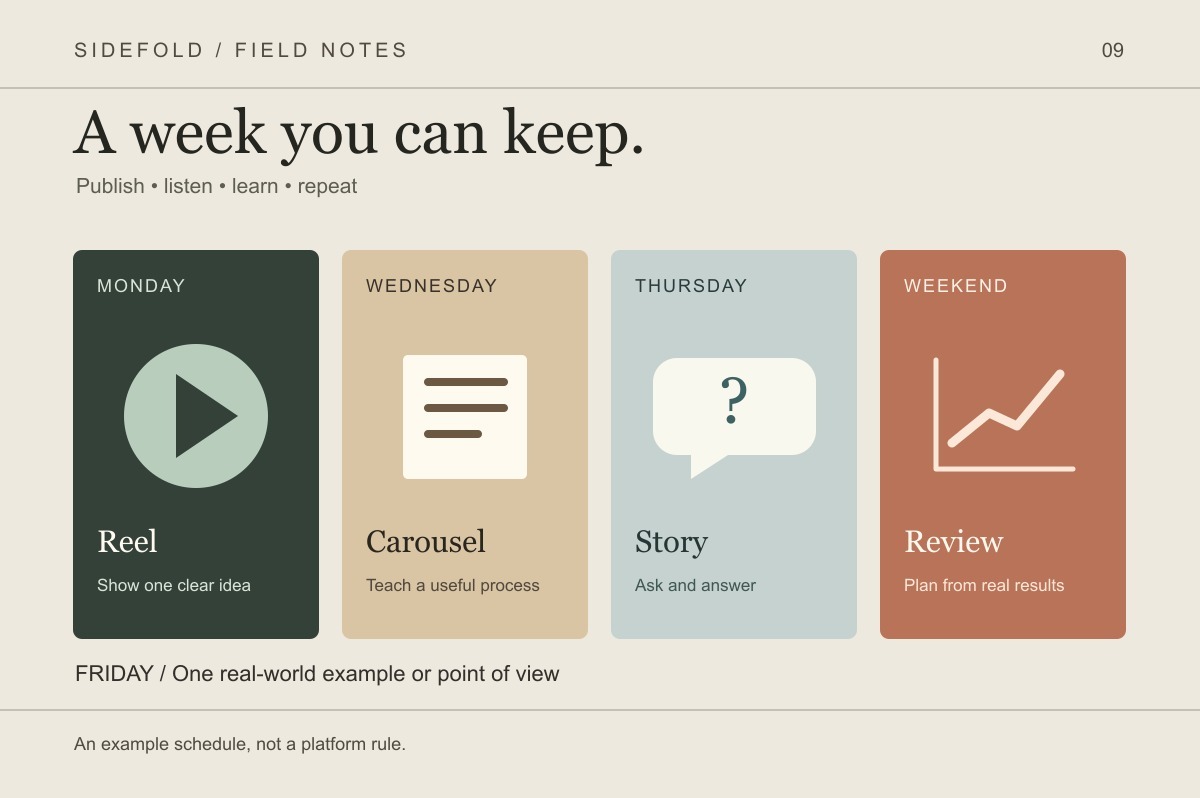
Try this weekly posting schedule
This is an example for a solo creator with limited production time. In a separate Buffer analysis of 2.1 million feed posts from 102,000 accounts, weeks with three to five posts were associated with roughly 12% more reach per post than weeks with one or two. The study did not include Stories or prove that posting frequency alone caused the difference. If three feed posts are too much, start with two and keep the review.
| Day | Publish or work on | Purpose |
|---|---|---|
| Monday | One original Reel | Show a result or answer one common question. |
| Tuesday | Reply and collect questions | Turn real comments and DMs into the next ideas. |
| Wednesday | One useful carousel | Teach a process or compare options. |
| Thursday | Story with a question or update | Continue the topic and hear objections. |
| Friday | One example or point-of-view post | Show your method in a real situation. |
| Weekend | Review, plan, and batch | Keep what worked; prepare next week. |
Batch the parts that benefit from preparation: outlines, filming, covers, and captions. Keep some space for timely questions. If you have a professional account, Instagram supports scheduling eligible posts and Reels in the app; check the composer for features available to your account. See Instagram’s scheduling help.
05
Choose times by testing your audience
“Best time to post” charts combine accounts with different locations, habits, and topics. Choose two or three realistic windows in your audience’s local time, then alternate them across comparable posts. Avoid judging a time slot from one unusually strong or weak post.
Use your professional dashboard to inspect account and post insights, including the audience information available to your account. Meta also offers personalized Best Practices there, including guidance on posting frequency, attention, engagement, and reach. See Meta’s Best Practices overview.
Record the time, format, topic, and result together. If one time window seems stronger, repeat the test before changing the entire calendar. Your ability to answer comments soon after posting is also a practical reason to choose a window you can actually attend.
06
Make growth a conversation
Reply to specific questions while the topic is fresh. Ask for examples you can learn from, then turn a recurring question into a post that helps more people. Collaborate with a creator whose audience overlaps yours when you have a genuinely useful joint idea.
Give people a reason to share the post with someone else: a checklist, a clear demonstration, a helpful comparison, or a story they recognize. Meta introduced reposts that can carry credited public posts and Reels to another person’s followers, but sharing is a reader choice, not a growth switch you can force. Read Meta’s repost update.
If a post promises a guide or product list, make that destination easy to find from your profile. Our link-order guide shows how to match the first link to the post that sent a visitor.
07
Review four weeks, then change one thing
At the end of each week, note each post’s topic, format, publish time, reach or views, shares, saves, profile activity, and follows where Instagram shows them. If the goal is a resource visit, check its clicks or signups separately. A view is not the same as a follow, and a profile visit is not the same as a download.
After four weeks, compare similar posts and look for a repeated pattern. Which questions drew useful replies? Which posts reached people outside your followers? Which prompted a visit to the promised destination? Keep the formats and topics that serve your goal, then adjust one variable such as a time window or opening frame for the next month.
If a Reel underperforms, use its available watch-time insights to see whether people stayed long enough to reach the point. Meta describes watch time as another way to assess Reels beyond view count. See Meta’s Reels insights explanation.
08
Common questions
How often should I post on Instagram to grow?
There is no universal number. Start with a cadence you can sustain, such as three useful feed posts a week, then review your account's results and the personalized Best Practices in your professional dashboard. Increase frequency only when you can maintain the quality and respond to people.
What is the best time to post on Instagram?
There is no reliable time that works for every account. Test a few time windows when your audience is likely to be available, compare similar posts over several weeks, and use your own Instagram Insights to make the next choice.
Do I need to post Reels every day?
No. Reels can help new people discover your work, but a daily video target is useful only if you can make distinct, relevant videos at that pace. One strong Reel and a helpful carousel can be a better starting week than seven rushed posts.
Make next week’s calendar from one real question.
Choose the question, publish an answer in two formats, and check what your audience does next.